Friday, 12 July 2024

Plas Newydd

Another boater that was moored next to us when we arrived, told us about their visit to Plas Newydd, an historic house in the far side of the town, just over a mile away (but up and down steep hills either side!) The forecast for today gave around 30% chance of rain all day but by late mid morning it felt as if the wet was giving us a day off.

We left the boat around 10:45 and walked into the centre of town where Christine managed to pick up a bargain walking pole from a small hardware shop that displays a sign saying 'Camping'. It was immediately put to use as we now climbed up out of town to Plas Newydd.


This historic house was first made famous by the Ladies of Llangollen: Lady Eleanor Butler and Miss Sarah Ponsonby who moved here from Ireland in 1778. Before then it had been a farm cottage, very plain and anonymous. At first the ladies leased the property but gradually bought it, completing the final payment not long before they died.


We bought our tickets at the tea room near the entrance and then walked across the grounds to the house where we both took the option of using a small device for a recorded commentary in each room. It would automatically start the appropriate piece when pointed close to a sensor in each room.


The ladies lived here for around 50 years and were well known for hospitality to visitors. Few stayed overnight as their hosts valued their domestic privacy but quite famous people are listed in their visitor diary, including the Duke of Wellington and Sir Walter Scott. )It seems that the above is the only known portrait of the ladies and was painted when Eleanor was all but blind from cataracts and could not see the artist - she is said to have especially disliked being drawn)


For most of the time here, the Ladies were attended to by their live-in servant, Mary Caryll, by all reports a most formidable but well educated Irish woman. All the local tradespeople were in awe of her, especially her ability to haggle the price of everything.


The most striking aspect of the house, as now largely restored back to what it looked like when they died, is the extensive collection of old carvings which they rescued from other houses when they were    being modernised and such decoration became unfashionable. Almost every square centimetre of wall is covered by a patchwork of carving. They aimed to make it as Gothic as they could. Their lifestyle, although unusual at the time was quickly accepted, especially as they did much to alleviate the needs of the poorest families in town.


The house was not large, with one bedroom which the Ladies shared and one kept for visitors. The latter is notable for having a night bolt on the door which could be operated by a cord from the bed.


It also had a Powder Closet, a fashionable feature at the time. This comprised a small room, barely a cupboard, in the corner of the room with a hole in the door large enough to put a head through. Powdering hair was a complicated process and risked scattering powder everywhere. The maid would be inside the closet and a lady's head poked through form it to be dressed. The style died out when the government of the day put an 'extortionate' tax on it. However, the term lives on in the now somewhat dated expression of 'powdering ones nose' as a euphemism for going to the lavatory which the closet was converted into. It seems that the Ladies kept powdering throughout their lives which must have added to the impact their presence made on visitors.


The servant's room, in the attic, was quite a contrast.


After their deaths the belongings were auctioned off and a succession of owners followed, the most influential being General John Yorke who added the back and white style to the exterior. He did not live here but kept it more as a museum for his collection of curiosities. He preferred to stay, during his visits, at a nearby coaching inn. Later owners added two wings but by the start of the 20C the property was much neglected and was eventually sold to the local council in 1932 who initiated the practice of opening it to the public. 


It quickly became popular and enhanced it reputation - the fame is evidenced in its used by Shell in a series of promotional Landmark .pictures by leading artists of the time

Sadly, the Council's commitment did not extend to good maintenance and the extra wings developed rot and had to be demolished in the 1960s so that what remains is close in scale to how the Ladies left it.


The estate was broken up in one of the previous auctions and the gardens which remain have been remodelled on what little is known of how the Ladies kept them. One special feature of the location is that from the upper windows at the back of the house there is a splendid view of Castell Dinas Bran, a ruined medieval castle on the hill across the Dee valley.


This mosaic is a tribute to the two Robertsons, cotton brokers from Liverpool, who bought the property 1890 and added the two wings as well as enhancing the formal gardens.


After we completed our tour, which we found most fascinating, we walked back through the town, collecting bread, milk and carrots on the way, and called at Llangollen Wharf to pay for another two night's stay.

Thursday, 11 July 2024

Bus Trip to Barmouth

We opted to book at least two nights in Llangollen when we arrived yesterday but later agreed that we may well stay a bit longer (yet to be determined!) and explore some of the wider region. Alas, that did not take into account the weather, which today had but a few good moments.

The coast nearest gto here is quite unfamiliar to us and so we took the T3 bus from just below the canal to Barmouth, passing through places such as Corwen, Bala and Dolgellau. The trip took two hours each way and the road was very winding almost the whole time. 

At first the A5 road followed closely the Cambrian Heritage Railway to Corwen. Here we had the first experience of seeing our driver squeeze the bus through some seemingly impossible narrow streets. Just one improperly parked car would bring the whole town to a standstill. Like most places, every feasible on street parking space is designated with great care.

From here we passed through nothing but tiny hamlets, many with their own small church or chapel and extensive graveyard, well tended in most cases.

Bala was immediately followed by its eponymous lake, the largest natural lake in Wales. It already held that record before Jessop and Telford made improvements to increase the  water holding in order to supply the Ellesmere Canal, later renamed the Llangollen Canal. As we know from the flow that we battled against n the way up, especially yesterday, it still is an important water supply but now also for domestic uses as well.

From Dolgellau it was another half an hour to the coast but for some time we were close to the edge of the estuarial inlet. Here Afon Mawddach ends it journey to the sea bringing water down from Snowdonia.

As soon as we arrived at Barmouth walked down to the promenade where we quickly opted for coffee at the Pavilion Cafe. The seafront is typical of English and Welsh resorts with their roots in the times when railways first enabled working families to have holidays away from home. We were surprised how quiet it seemed, almost out-of-season instead of just approaching to main school holiday period. Even the funfair rides were silent.


On large group had commandeered a section of the beach and in traditional manner stuck to their mats, windbreaks etc whatever the weather.


Looking to the other end of the beach, the sand was all but isolated. By now there was a glimmer of hope in the weather - the low cloud over the hills hung around but it was warm enough for Mile to sit on one of the many benches on the promenade - not may other takers. But it was pleasant enough. 


Whilst he sat and read a book, Christine continued on the the end of the prom where, looking inland upriver, she could not only see the few sailing boats moored here but also the spectacular railway bridge that connects the Cambrian coast to Shrewsbury and Birmingham (trains every hour)

Almost the only significant feature along the front is the substantial lifeboat station where crew were keeping the boat ready for action. Sign of the times: the only tool that we could them using was a laptop!

We walked the short distance into the centre of town looking for somewhere to have a snack lunch. The shops and cafes all fitted in with the seaside resort atmosphere with nit a lot of variation. In the end we went back to the Pavilion as we could sit outside, under cover, and look out to sea.

By the time we had finished and started to wander in the other direction of the promenade, rain swiftly arrived, visibility of the hills vanished and we sheltered for a while on platform seats at the station, which is only a short hop from the bus stop.

Our plan now was to take the first part of the return bus to Dolgellau as the timetable seemed to suggest that the next through bus to Llangollen was much later. The planned wander to the riverside gardens and tea in the town centre  was washed out and we suddenly realised that the T3 bus service continued in a few minutes, but with a different bus. We would also have to change to a T3C at Corwen. Spending two hours in pouring rain with no guarantee of a sheltered place to read did not persuade us not to board the next bus immediately!

And so we returned to the boat. Expecting to be rather later back, Mike had the morning before we left prepared a beef mince pasta bake that could just be heated up when needed. UK weather quickly causes even the best plans to evaporate.

Wednesday, 10 July 2024

Llangollen

Today's Canal : Llangollen


We did not want to arrive into Llangollen too late as we were uncertain about the extent of available moorings for the next few nights. As a result we were away promptly at 9 am. Early mist had quickly cleared way and we left with bright sunny skies.


We left behind a precisely measured  Alchemy sized slot - and a good number of longer stayers.


The canal soon took on a new character for the remainder of the route into Llangollen - increasingly narrower! At this stage it was still two-way but often the bends meant that we had to back off and draw to one side, especially with less experienced steerers.


Just before Chirk Bank, the canal runs at almost roof level with the houses on the adjoining road.


The quirky garden design at Monks Bridge (always good for a photo!) looks as if it has had a bit of a makeover and now indicates that any donations go to a charity. Alas, getting through the bridge makes finding and coins an impossibility.


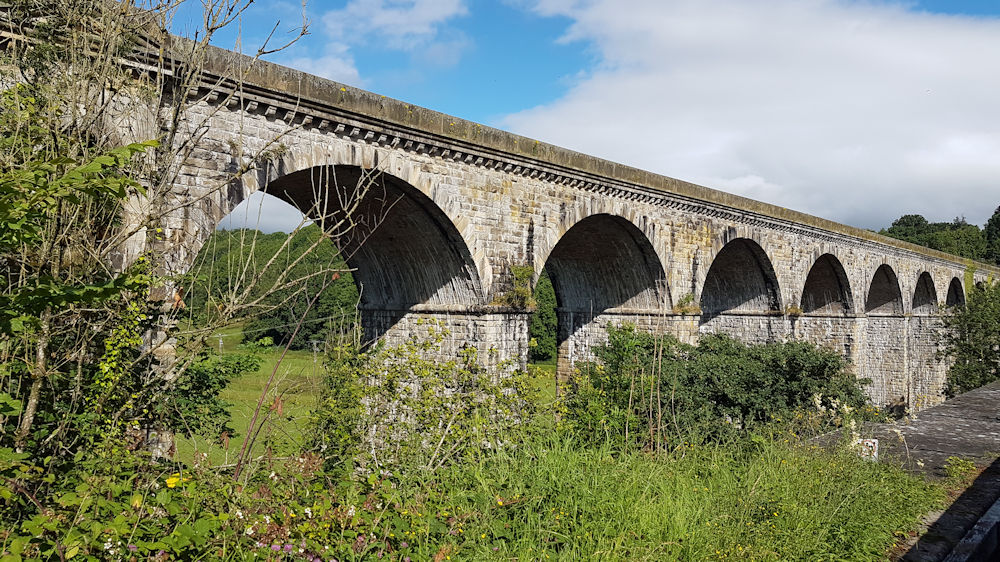
Soon we could see the impressive view of Chirk Railway Viaduct that runs close to the aqueduct which we then also crossed. Fortunately we were close behind another boat that was part way across so we did not have to worry about a fight for position with oncoming boats! As we neared the end a couple came throiugh the tunnel so did niot have a long wait. However, the flow on the canal as well as the narrowness means that our speed would make a snail look electrifying!


We were able to go directly into the tunnel but again we were amazed at how long it took us - 15 minutes for just over 400 m!


The next stretch is an impressively wooded cutting that totally hides the large industrials works to the north.


This wall, nowadays barely visible, seems to be a hint of something significant in the past. Later, looking at old maps from before the industrial site developed, there were a number of busy collieries and quarries around Trevor. A network of tramways existed before the start of the 20C and it looks as if this wall was at Bottom Wharf with one line running very close to the canal.


Whitehouse Tunnel is shorter but we had a bit of a wait for a boat to emerge as it was already in when we arrived.


Nearing Froncysyllte there are long lines of moored boats, long term on the village side, which reduce the width to single traffic. A steam of on-coming boats was very determined not to allow a gap to develop between them that might allow us to slip in! It was even more aggressive at Fron lift bridge just ahead! A boat going our way had opened the bridge and was just passing through as we arrived but a convoy that had recently crossed over the aqueduct insisted on preventing us from following. The last almost closed the bridge on us until we tooted to draw its attention to our presence.


Christine steered across Pontcysyllte - it took just over 10 minutes but felt a lot longer. Towards the end quite a breeze developed. If you want spectacular high level views, this is the place to come. 

Three boats were waiting to cross but before the last could set off, another boat raced through the narrow bridge that marks the start of the final four miles into Llangollen. It nearly collided with one of the other boats and Christine had to take evasive action as well. As we started through the bridge several canoes came though without warning, seeming to think that they were invincible!


The last section was less busy although every boat passing took care and attention. The canal is narrow and the lie of the land very steep. A couple of bridges illustrate the difference from one side of the canal to the other. 


There are two sections that are clearly signed as single boat width and boats are encouraged to send a crew member ahead to avoid confrontations. The first has a single passing place - Christine warned Mike of an oncoming boat so he was able to hover in the extra space to let it pass safely. She also had to ask a boat to wait at the other end of the second narrows - no passing place at all - it seemed a bit miffed/mystified but it ought to have known what to do as they must have come this way earlier!


We continued on and eventually arrived at Llangollen Wharf where, in the tea room and trip boat office Christine bought two days worth of mooring but also learned that we could top this up to a five day maximum if we wanted it later on. The permit covers both the towpath moorings which we had just passed and were largely unoccupied as well as the pontoons in the basin a little further one - this marks the end of the generally navigable water.

We opted for the latter - the towpath seemed a bit busy - the basin was perhaps just over half full. We soon tied up and had a rather late lunch.


Late afternoon we wandered down to the town, mainly to check out various options for things to do. The heritage railway station was just closing with the arrival of its last train of the day.


We could also see a white water raft tackling the falls on the Dee as it reached the town bridge - look very carefully and you might spot it in the centre! As far as we could tell, it successfully negotiated its way without losing any of the passengers!


Across the bridge and into the town, Christine found Mike a couple of long sleeved shirts - we packed  assuming that this trip would be generally warm! - as well as an inflatable cushion she had been seeking for herself, for several purposes, mostly to do with more comfortable sitting or sleeping.

9.3 Miles - 0 Locks

Tuesday, 9 July 2024

Gledrid

Today's Canal : Llangollen

Today was largely wet with very little mitigation - to be fair, we did see sunshine for two minutes  towards lunchtime but proper rain returned mid afternoon. However, the temperature was milder than the some recent days (apart from yesterday which turned remarkably hot)


This accidental selfie shows how Mike had to wear a hat to prevent his hearing aids from being harmed by the rain! They do not like getting wet. (DAMHIK)

We thought that the canal was somewhat quiet when we set off and only one boat passed us going in our direction. 


The wharf at Maestermyn is now home to Whittington Wharf hire boats - we have seen several in the past few days. This used to be home to Maestermyn Hire Boats which disappeared in seemingly mysterious circumstances around six years ago.


At the end of the wharf is a small collection of traction engines - two on a trailer presumably to be taken to some of the annual agricultural shows which delight in being reminded of how the industry first began to be mechanised and less dependent on horsepower.


This bridge once carried part of the Cambrian Railway (not to be confused with the Cambrian Line, a modern name for remaining services along the coast and inland to Shrewsbury) on its way from Whitchurch, through Ellesmere to the Welsh coast at Aberdovey. A very short section of the line remains in Oswestry as a Heritage Line (originally the head office for the Cambrian Railway company).


After cruising for about an hour we reached the two New Marton locks - and promptly joined a queue as third in line. By the time we were able to go through ourselves the line extended at least six back! This location is notorious for long waits and it certainly lived up to its reputation for us. As we waited there was a steady flow in each direction, one up, one down. However, by the time we left the top lock, no-one was waiting. Quite a few of the hire boaters were facing a lock for the first time and welcomed some comforting support!


We first saw this trunk two years ago when it had just been painted this way after the rest of the tree had fallen down. See here for our notes on how it is called Solidaritee. Hard to imagine what life must be like for Ukrainians after more than two years of unrelenting war.


The obligatory picture of Lion Quays - but with a different moord boat from previous times!

All morning, the Visitor Moorings were either empty or with a solitary boat. We planned to stop for lunch around Gledrid where there is another VM marked on our map. We were surprised to see a long line of moored boats, fender to fender, but when we spotted a gap we quickly measured it, finding it a feasible if snug fit.

Only later did we realise that we were about 300m away from the proper mooring but after some discussion we opted to stay put. A number of boats continued to pass as we had lunch and we were concerned that finding a mooring late afternoon might not be too easy. In any case, at the time we might have been crossing the Pontcysyllte Aqueduct, a very heavy downpour arrived. We experienced wind and rain crossing the aqueduct in 2017 so not keen to have to do it again.

5.5 Miles - 2 Locks


Monday, 8 July 2024

Welsh Frankton

Today's Canal : Llangollen


By the morning the rains had cleared and it was a bright and sunny day. We could now see our mooring spot in all its splendour.


At least one person was swimming in the mere.


We set off in good time, but not too early, trying to judge our arrival at Ellesmere in between departures from the moorings at the wharf and new arrivals. First, we had to pass through the short Ellesmere Tunnel. As with elsewhere, the entrance to the tunnel is at an angle and it is only possible to if the way is clear at the last moment,. with the bow almost inside the portal. Today we were lucky.


A little later we arrived at the junction where the Shropshire Canal's head office was based and the short arm to the town wharf begins.


Timing was great as there were at least five spare slots and we found one almost outside Tesco - good for carrying heavy shopping back to the boat later. before tying up we turned around in the main basin. It is possible to moor right top the end but the last two spaces are at risk of being hit by less experienced boaters, or those with 70 ft of steel to ram with. (Actually just before we left, an arriving boat spotted one of these spaces and was so determined to grab it before another waiting boat that they failed to watch their own and ran into us. No real harm done.


We locked up and waked the short distance into the town centre. Close to the wharf we spotted two former canal buildings, now converted into smart dwellings.

A deli and butchers have been favourites of ours on previous trips and so we headed in their direction (next door but one to each other) calling at the pharmacy on the way for Christine's prescription.

We bought a couple of loaves, some cakes and a pork pie at the deli and an assortment of sausages, mince, meat and two 'burger trifles'. These latter have a burger squashed in the middle, some sort of stuffing in the middle and bacon wrapped around the outside. Christine rang them later when she decided that she needed guidance on how to cook them tonight!

Back at the wharf we dropped the first instalment of shopping at the boat and proceeded into Tesco for what remained. Swell, almost all, as later we decided that we needed more eggs and Mike was despatched at the end of lunch to get some. Well, Christine was doing the putting away of lunch things . . .

At last we found an internet signal whilst on this mooring and so some time was spent uploading the blogs for the last few days blogs and answering emails.


We had to return down the arm to use the 'boater facilities' alongside the dry dock that was once part of a large canal maintenance depot.

J


ust beyond the yard on a sharp bend the work boats had been moored, using both sides. Now, work boats have a bit of a reputation for taking a rest in inconvenient spots, often alongside a sign that says two days only, but the Rothen boat was especially badly placed. It is even worse from the other direction as the end really does stick out and the bend means that oncoming boats cannot be seen until almost too late.

The rest of the afternoon was a slow meander without any stoppage for locks, lift bridges or shops.


This smart Canal Cottage looks as if it has been twice extended from when it was perhaps a lengthsman's home, along with his large family.


We passed Frankton Junction at the start of the Montgomery Canal, the first set of locks just in view. If we have time we may well go down on the way back, provided that we remember to book in time and whilst we have a phone signal!


We moored for the night in a quite spot about half a mile further on, at a good Visitor Mooring. The Shropshire Union Canal Society have done a great job in creating numerous moorings usually with rings and they also routinely cut the grass even when the rest the towpath is all but overgrown. After a slow start in the poor spring, greenery everywhere has grown enormously.

Miles - 0 Locks