Today's Canal - Chesterfield
Last night, after we had posted the blog, there was a wonderful sunset.
We had moored overnight on the end of the lock landing so we were keeping an eye our for any early moving boats - just when we thought that there would be none when along came a work boat. As a result we let them out so that they could drive straight out of the lock. They were heading down to near Retford with a load of stone for mending a collapsed towpath edge.
It turned out to be a rather warm day but was alas overcast for much of the time, despite the red sunset last night.
The four Forest locks are well spaced out - just too far to walk between them. However. we found most of the narrow locks so far to be pretty easy to operate - the only issue is with some of the anti-vandal devices. Some of the locks on the paddles do not work although we have not had any case where both were out of action. That would be rather difficult!
At the third lock there is a full set of services - and just below we found the weed cutter, but at this stage it was just tied up.
As we completed our servicing, the two crew of the weed cutter arrived and set about fuelling up and then brought the boat up through the lock. They were not ready when we were so we set off ahead of them but they did follow us for some while.
When we came this way five years ago, the lock cottage was in a very sorry state but someone had just bought it and was at the very beginning of gutting it as a prelude to restoration. It now looks a very well appointed home.
Although the canal was built as a commercial enterprise and served several industrial areas, most of that industry has long since disappeared. Even some of the former wharves, used for loading local goods traffic, are barely discernible without an old map to point them out. Now the canal is, for most of its length, through very attractive countryside.
Generally we progressed better than we recall from last time. The marginal reeds are much less invasive and the blanket weed is being kept almost under control. There is still plenty of it and it would soon take over if it were not for the efforts of the weed boat.
Mostly we have coped with the shallow depth but we did come firmly aground at the approach to the top Forest lock, just a few feet ahead of the official lock landing. No amount of engine and tiller action would free the boat, nor would pulling it with ropes. In the end we had to resort to using the pole for the first time on this boat! After much effort we eventually floated free.
It appears that the lower part of the lock has been rebuilt at some stage, perhaps to make it easier to operate the bottom gates. No attempt was made to remove the original coping stones.
Green Mile Trees is a nursery that grows a large variety of different trees - some looked really special.
At Ranby we had to negotiate our way around a dredging operation. Today was also being run as an Open Day and there did seem to be a reasonable number of visitors including a school party of young children. A little further the dredging were being offloaded into an adjacent field.
The next stretch is very bendy -some of the turns barely have enough room for a full length boat - and at times the bridges ahead seem to be in entirely the wrong place.
Mill Farm at Osberton had strange looking canopy - was it a sun shade for the animals? No, as we saw a little further on, it was a substantial solar panel array.
We paused above Osberton Lock for lunch which gave Mike time to inspect the weed hatch. We had some difficulty coming out of the top of the lock - it turned out that it was not all down to the large amount of weed that had drifted down to the mouth of the lock as a large vest or t-shirt was also caught in the propeller. Shortly after we moored, the weed cutter arrived.
As we neared Worksop, we could see the tall chimney and building of Bracebridge Pumping Station. Now empty, it was originally built as part of the town's sewage system but now awaits someone brave enough to convert it into a new use. Plans have been agreed to convert into apartments but perhaps the long term liability of the chimney is a deterrent.
Someone likes lilies.
Most of Worksop's canalside industry is no longer visible but this former site has been converted into small studios and workshops under the name Creative Village. Some of the buildings were originally a fire station, stables and an electricity works.
Worksop Town Lock is awkwardly under a modern road bridge - no doubt it was built in the time when the canal was closed and how to operate the bottom lock gates was not a design consideration. The balance beams are cranked and almost disappear under the bridge.
Whilst Mike finished off bringing the boat through the lock and onto the short visitor mooring ahead, Christine popped to the shops - twice! We only went a short distance to the edge of town to a pleasant and quiet spot just below Morse Lock.
8.3 Miles - 8 Locks
Tuesday, 13 June 2017
Monday, 12 June 2017
Beyond Retford
Today's Canal - Chesterfield
We drove up from home yesterday. As we both had church duties in the morning it was a little before 1 o'clock hen we eventually set off. However, the roads were very clear and only for a couple of short stretches were all three lanes busy. With only one comfort break we arrived at Clayworth just after half past six, a but better than we had anticipated.
We had come with the evening meal already prepared and remarkably little unpacking to do. We also knew that a tv signal was possible - since we had found that on our last night on the mooring before setting off home last week - so that we could at least watch the first episode of the latest Poldark series. Not that we did especially well at scene spotting!
The downside of the otherwise excellent mooring at the Retford and Worksop Boat Club was that we found one cabin side and the roof liberally splattered with bird droppings from the overhanging trees! Since this can eat into the paint of left to harden too long, Mike was 'commanded' to clean it all off before we set off! It does take some elbow grease and several cycles of washing using mop, scrubbing brush and sponge (not to mention fingernails!) to dislodge it all. We needed to fill the water tank so reversed back to the service moorings outside the club house - only to be told that there were water points all along the moorings, just not visible in their little brick huts! A final hose down of the roof and side left us really quite respectable again. All we had to do was to sort out payment for the electricity we had used. We had opted for an experiment to see how well the fridge and freezer would do when left alone for a week. We were quite relieved when we arrived not to encounter a defrosted freezer! Mind you, we had not gone overboard, as it were, in the amount that we had left in either fridge or freezer.
Shortly after eleven we were ready to set off. Much of the Chesterfield is shallow and progress not speedy - at least that gives more chance to survey the canalside scenery. However. Mike failed to spot two brightly dressed scarecrows in a field and by the time Christine suggested a photo opportunity they were almost out of sight. Still, we can try and remember to have a better attempt on the way back.
We were looking out for milestones - most seem to be in place but the vegetation sometimes makes them hard to spot.
Alongside an overflow weir, was this young family about to have a beginners forced swimming lesson?
This stone circle seemed to be nowhere special so we are not sure who built it or why.
The day was generally overcast and at times rather windy, at least there was no rain, despite a slight dampness at one point but the showers passed either side of us. However, there were some sunny spells, such as when we arrived at Whitsunday Pie Lock, on the outskirts of Retford. This is the last of the wide beam locks - from Retford upwards they are narrow. We moored below the lock to have our lunch.
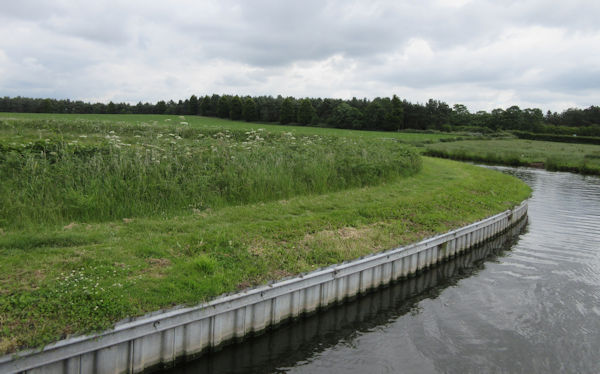
At the edge of town we found that the towpath bank is well piled and so, suddenly, without changing the engine settings our speed almost doubled and it felt as if we were speeding through the water! Alas it did not last and after we passed through the town, normal service was resumed.
We moored for lunch just below the first of the narrow locks so that Christine could pop to Asda which is right beside the canal at this point.
Just above the lock we saw that the former warehouse is being restored and converted to new uses. This is a positive step - when we came five years ago our photo shows that it was almost derelict and not in use.
The top gate of the lock carries a popular footpath into town so quite a crowd gathers whenever a boat passes through. Fortunately on this occasion an onlooker offered to close the gate for us so people were a little less delayed than if we had had to stop. However, this threw us out of our routine and as we were just passing a moored boat Christine spotted that we had forgotten to close the paddle on the towpath side. Again, good luck - or kindliness - was on our side as a chap on that moored boat offered to go back and close it for us.
Our plan was to go beyond Retford into the open country, but not to start the run of locks that is for tomorrow. Sadly, this long, excellent looking bollarded mooring was a little too soon and, in any case, was overlooked by tall trees.
A field with poppies - the slightly unfocused image almost makes it look like an impressionist painting (well that's our excuse!)
Mike was aiming for a mooring marked in the Richlow Guides, just below the next lock. He kept an eye open for a possible mooring before then but it was not possible to get even within jumping distance of the bank.
When we arrived it turns out that the marked mooring is really part of the lock landing. However, as we have not seen a single mooring boat all day, and it was by now gone five o'clock, we tied up anyway. let's hope that the mooring police are not monitoring this blog.
6.6 Miles - 3 Locks
Friday, 2 June 2017
Clayworth
Today's Canal - Chesterfield
Today was generally overcast but with a warm temperature. At times it felt rather humid.
We were in no hurry as our mooring place for the next week was not far away. We left our overnight stop alongside Drakeholes Tunnel a little after 10:30.
Passage along the Chesterfield is never a speedy affair but the first section was especially slow. After a while we did speed up a bit. When meeting a boat coming the other way, it is often necessary for one to come to halt, temporarily grounded whilst the other takes the 'deeper' water in the middle.
The first bridge we came to has several names: Nicholsons lists it as Old Man's Bridge, whilst Richlow have it as either Lady's or Manface Bridge! Richlow also says that it was formerly called Wiseton Coach Road Bridge. In any event, the bridge was constructed a little more ornate than most of the others nearby, with a carved bearded man's face at the apex of the arch on either side. Sadly, much of the detail has weathered away but if you look very intently you can convince yourself that it is really a man's face!
We continued slowly, enjoying the scenery, until we reached Clayworth. With some effort we managed to pull alongside just before the line of moored boats so that we could checkout whether it was possible to take up our mooring a day earlier than originally requested. Yes, that would be fine.
We moved down to the service mooring for thew usual activities before being shown to our space. Certainly we have found people here very friendly and helpful. We also, unexpectedly, discovered that there is an electrical hookup so we will probably try leaving the freezer on for the week.
After some cleaning and other administrative tasks we drove into Retford for a quick visit to Morrisons and to fill the car's fuel tank ready for the long trek back home tomorrow.
On our return to the village we called at the parish church which was signposted as the Home of the Traquair Murals. Not that we had any idea what they were!
Inside the neat and tidy church we were impressed with the latest adaptation, to provide a catering area in the foot of the tower as well as a fully glazed sitting area just inside the main door. This can either be used for small meetings or for young children during a main service.
The murals are by Phoebe Anna Traquair (1852 - 1936) who lived and worked in Scotland, mainly Edinburgh. She worked a lot in tapestry but completed six murals in various public buildings, two in England including this one at Clayworth. The information panels did suggest that her style fell out of fashion in her later life but that there has more recently been a resurgence of interest in her work.
At the back of the church hangs a painting that depicts the church before it was restored and adapted in the late 19C. The work was overseen by the son of George Gilbert Scott, famous for the St Pancras in London. As a note says, fortunately the son did not emulate his father's Gothic style! One of the changes that he made was to raise the roof of the chancel (this was well before the Traquair Murals were painted) and visitors are invited to compare the painting with the view outside.
2.8 Miles - 0 Locks
Thursday, 1 June 2017
Drakeholes
Today's Canal - Chesterfield
Another glorious day. But first a few pictures from late evening yesterday, taken on a wander around the basin after the blog for the day had been uploaded.
Another bright morning.
We left the mooring and turned immediately a sharp corner under the road bridge. We soon found that our speed along this canal would be a fraction of our hair-raising stampede yesterday. The weed is not yet a major problem but the nearness of the bottom to the surface of thew water is. At best we can make 2 mph and sometimes rather less.
After passing through the two Misterton locks we moored at Wharf Bridge so that we could walk into the village for a small amount of shopping. A sign that looks like it should be attached to a pub stands by thew waterside. In fact there was an old pub here until 2002 when it closed and was subsequently demolished. The recent housing development is now called Packet Landing.
There was a small but well,organised Co-Op that is the main supplier for the village but also an independent butcher. Mike bought a pork pie and a haslet ball - it had just come out of the oven so he was told to unwrap it as soon as back at the boat and to let it cool before putting in the fridge.
We continued as it was not yet lunch time.
Winding holes are not very frequent - so where does a large work boat choose to moor - with no-one around it is clearly left there long term!
The Lower-Richardson (Richlow) Guide (sad that they did not find anyone to pass on this valuable resource for updating) gives a 'suggested rural mooring' a little before the next lock. We recall the lack of reasonable moorings from our previous visit but also that where they are marked they were usually occupied. Hence it was a relief that this one, with room for at least three boats, was entirely empty. It also has a reasonable edge for mooring.
We stopped here for lunch but were in no hurry to set off again. It is not far to Clayworth where our mooring is to be found so no real rush is needed. A boat going down a previous lock had just left the boat club moorings and knew about our anticipated arrival - we may well be in their usual space but they are off for a long early summer cruise, including crossing thew Wash from Boston to the Middle Levels.
On again and we passed a couple of former brickworks. These were linked with some of the last commercial traffic on this canal. One of them looks as if it is little better than a rubbish tip and the other is splendidly isolate in the middle of a field.
After a long slow stretch, seeing no moving boats, we neared thew sharp bend just ahead of Drakeholes Tunnel. Of course, as we were just about to go around we could see another boat already coming around and had to wait for it - there is no room to pass anywhere but on straights - even then, it is frequent that one boat has to stop, lodged on the shallow edge of the canal.
There was also a boat in the tunnel - they seemed to be taking it very slowly as we hung around just outside!
We were fortunate that there was still plenty of room at the moorings just after the tunnel - these can be quite popular in the summer and early arrival is needed to secure a place.
6.5 Miles - 4 Locks
Another glorious day. But first a few pictures from late evening yesterday, taken on a wander around the basin after the blog for the day had been uploaded.
Another bright morning.
We left the mooring and turned immediately a sharp corner under the road bridge. We soon found that our speed along this canal would be a fraction of our hair-raising stampede yesterday. The weed is not yet a major problem but the nearness of the bottom to the surface of thew water is. At best we can make 2 mph and sometimes rather less.
After passing through the two Misterton locks we moored at Wharf Bridge so that we could walk into the village for a small amount of shopping. A sign that looks like it should be attached to a pub stands by thew waterside. In fact there was an old pub here until 2002 when it closed and was subsequently demolished. The recent housing development is now called Packet Landing.
There was a small but well,organised Co-Op that is the main supplier for the village but also an independent butcher. Mike bought a pork pie and a haslet ball - it had just come out of the oven so he was told to unwrap it as soon as back at the boat and to let it cool before putting in the fridge.
We continued as it was not yet lunch time.
Winding holes are not very frequent - so where does a large work boat choose to moor - with no-one around it is clearly left there long term!
The Lower-Richardson (Richlow) Guide (sad that they did not find anyone to pass on this valuable resource for updating) gives a 'suggested rural mooring' a little before the next lock. We recall the lack of reasonable moorings from our previous visit but also that where they are marked they were usually occupied. Hence it was a relief that this one, with room for at least three boats, was entirely empty. It also has a reasonable edge for mooring.
On again and we passed a couple of former brickworks. These were linked with some of the last commercial traffic on this canal. One of them looks as if it is little better than a rubbish tip and the other is splendidly isolate in the middle of a field.
After a long slow stretch, seeing no moving boats, we neared thew sharp bend just ahead of Drakeholes Tunnel. Of course, as we were just about to go around we could see another boat already coming around and had to wait for it - there is no room to pass anywhere but on straights - even then, it is frequent that one boat has to stop, lodged on the shallow edge of the canal.
There was also a boat in the tunnel - they seemed to be taking it very slowly as we hung around just outside!
We were fortunate that there was still plenty of room at the moorings just after the tunnel - these can be quite popular in the summer and early arrival is needed to secure a place.
6.5 Miles - 4 Locks
Subscribe to:
Posts (Atom)