Today's Canal - Leeds and Liverpool
The forecast for today was a complete change from the extreme heat of the past few days - very much cooler and with showery rain for most of the day. We began dry but by late morning the rain could resist no longer and for the rest of the day rainwear came and went as needed.
Today we had almost as many swing bridges to negotiate as locks, but a bonus at the first when we found it 'normally left open' although not marked as such on our guide maps. It is only a farm accommodation bridge between two fields and, although we have had to operate it in the past, it has now deteriorated to the state in which it would need a repair before it could be moved again.
This 'tiny but perfectly well formed' narrowboat was moored just at the entrance to Apperley Bridge Marina. Inevitably, given its given name, the quote is "There is nothing, absolutely nothing, half as much worth doing as simply as messing about in boats , said Ratty to Mole".
We spotted this interesting row of cottages just below the Dobson Staircase Locks several years ago when we chatted to a person renovating some of them. Looks like a good job! We used the disposal facilities above the locks. But left the water until later.
Perhaps we should explain: ahead of us are the Bingley Locks, a three rise and then the famous Five Rise. These are manned and, originally for water saving reasons last year, they also operate on restricted access times. In each direction there are just two shortish slots to enter the flights. To go up today meant that we needed to be ready at the bottom by four o'clock. To be reasonably sure of meeting this we set off at 8 am with a predicted arrival between 3 and 4.
So, this picture is heavily zoomed in and not as clear as we would have liked but it does give us a chance to mention a ;pint of interest. We have been following the electrified railway line in to Leeds for most of the time since we left the city. Apperley Bridge station is in the middle of nowhere but has this huge illuminated car park - this morning looking pretty full. We guess that it is a popular commuter service for people who want to live a more rural life style. It also accounts for the surprising amount of traffic at the previous swing bridge which is the main access road to the station.
Field Locks, another two rise staircase.
There have been plenty of reeds so far but this was the first time this journey on the Leeds and Liverpool we had spotted some larger water lilies.
The famous architecture at Saltaire - imitated by numerous other modern buildings in this area but not quite as impressive.
At Hirst Mill Lock we were assisted by a Walking Club group who were interested in what was happening - alas this was when the first heavy rain arrived and so they l;eft us to follow Plan B (lunch in the woodlands) or Plan C (lunch in the pub!)
At Dowley Gap locks, a team of three from CaRT were happy to take shelter from the rain whilst we came up - they were here to take the top gate paddles out of action, pending a replacement at the end of the season.
And so, at around a quarter to one we arrived to moor at the bottom of the Bingley Three Rise. It does not look as if there is a water shortage today. We had plenty of time for lunch and then for Christine to walk to the shops in Bingley town centre - she was given directions by a Community Warden who even insisted on showing her the way.
By the time she returned to the boat we were almost ready to set off - Andrew had chatted to the lock keeper who was happy for us to proceed even though half an hour ahead of schedule as there was a gap before the last boat would be ready to come down.
After reaching the top it is a short distance to the five rise - where we had to wait a little while for the lock keeper to reset the flight.
The first couple of locks had significant leaks from the gates above, in the second one there was enough to wash off the spare hand spike - Mike spotted this piece of wood floating behind him at the stern and, thinking this a bot strange for an otherwise so well cared for lock, he looked again. He thought, "I recognise that piece of timber" and so rescued it!
At the top we were rewarded by a view of the valley below, including the 'world class' Damart factory.
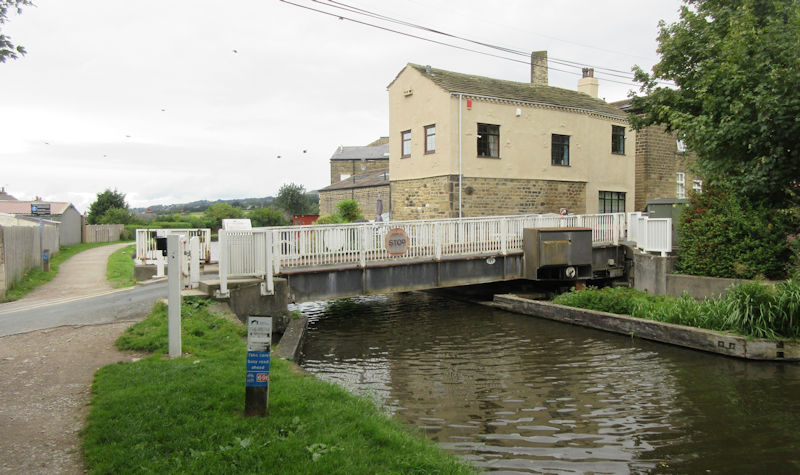
Then followed several swing bridges, all mechanised as the roads that they carry have quite significant traffic, busy at this time of day. At this one, Mike forgot to remove his key after closing the bridges and barriers, only realising when arriving shortly afterwards at the next bridge. Andrew kindly offered to go back for it, arriving just as another boat which we passed in between was about to make off with its unexpected present!
At another bridge, with automated barriers, a car jumped the red lights and narrowly escaped under with inches to spare before a barrier scraped its roof.
The final bridge is called Branby Bridge - the Marquis's pub, alas closed, alongside offers a "fantastic business opportunity" or so the agent claims! It is now 'under offer' so perhaps will re-open ere long.
12.0 Miles - 16 Locks (and lots of swing bridges)
Wednesday, 28 August 2019
Tuesday, 27 August 2019
Calverley
Today's Navigations - Aire and Calder, Leeds and Liverpool
Today was a day of two rather different halves. We set off with bright sunshine but before the end of cruising we had a few rather heavy, but brief, showers.
Just beyond where we moored overnight is this loading chute. We have not discovered its specific purpose but the land behind was a large glass bottle works, E. Breffit & Co, where they manufactured a number of different iconic bottles for retail use, including Lea and Perrins for North America and Horlicks.
We returned to Castleford Junctjon via the flood lock. When the canal was upgraded to take long trains of Tom Pudding coal boats, this lock was extended by adding a new upper gate with a basin between it and the original lock. All three sets of gates remain open except for flood times.
The River Aire was once lined by extensive industrial sites but today nature is well advanced in reclaiming unused areas and the cruise is quite relaxing.
The occasional reminder of the industrial times can be seen in former ,loading wharves, although even those are being overtaken with vegetation.
The first lock upstream is Lemonroyd, which is not only very long but also much deeper than the others between here and Leeds.
A photo of how a narrowboat looks lost is almost obligatory!
The right hand column of controls are various status indicators. The ones we used yesterday retain the original design ion which the light is the narrow strip surrounding what looks like a button. Almost always they are impossible to read. We were pleased to see that from here onwards new larger lights in the middle of the squares have been introduced and they were very much easier to see.
Alongside Woodlesford Lock is a small but well formed community apple orchard, complete with an information that gives the varieties - each tree is different.
The hills in the distance are all probably landscaped former waste tips.
Just before Fishpond Lock we had our first distant view of on-going building development in Leeds city centre.
Something is still happening on top of that hill.
Two bridges close together illustrate changes in design styles. The first is Concrete Bridge, a former railway line the served Skelton Grange Power Station, dates probably from the late 1950s whilst the Aire Valley Viaduct that carries the M1 was opened in 1999.
This house at Thwaites Mill (now an industrial museum) is rather grand - no doubts shows he wealth of the mill owners, probably earned at the expense of all the workers!
This unusual round structure stands opposite the lower entrance to Knostrop Fall Lock. Maps, old and new, give no specific indication but it looks as it it might have been a support pillar for a railway line that crossed the river and the navigation at this point.
Alongside the lock is the new Knostrop Weir, completed in 2017 as party of the Leeds Flood Alleviation Project. This, and another new weir further up, have made the Knostrop Flood Lock redundant and we were signposted on a new bypass route.
We continued into Leeds via the final Leeds Lock of the Aire and Calder. The centre of Leeds had been extensively redeveloped over the past few decades and there are very few disused sites close to the navigation.
This boat claims to be Leeds' only floating office and is available to rent, capable of taking a team of up to 10 people.
Another renovation project is well underway.
A water taxi continues to make frequent trips carrying passengers between River Lock and Clarence Dock, alongside the Armouries Museum. The steerer was kind enough to point out to us a shallow section on our side of the river.
And then we came to the second part of the day - the transition to the Leeds and Liverpool at River Lock.
Granary Wharf has gradually become known as a possible overnight mooring place but, as there are several nooks and crannies in the area there was room if we had wanted it.
Many people were using the towpath, it was lunchtime and we guessed than quite a few were taking time out from their nearby offices. Joggers and cyclists looked, as they checked their watches, as if they were on a schedule to get back to their desk! However, we wondered how many have even spotted this feature let alone ask why it is there.As we understand it, it was built to enable horses to escape if they had been pulled into the water, a not infrequent occurrence in the days of horse drawn boats.
Castleton Mill was once a flax mill but two years ago re-opened as offices for small businesses.
This looks like the development site we saw from far away early this morning.
This really does have to go into our Unusual Boats catalogue. As well as catching the eye with its very personal design, it has a sign offering various well-being courses and classes! Meditation, Easy Yoga and Drawing Club.
The next stretch of the canal, up to Newlay Locks, has long had a poor reputation, with many boaters feeling threatened by locals. As with other places, we feel that it is time to re-visit this reputation - we found the area increasingly pleasant with new housing helping to give the place a lift. Nevertheless, the long established summer activity for young people is using the locks as diving pools! It seemed at Spring gardens that the practice has not died out!
The supervisors at an outdoor activity centre did not seem to spot are imminent arrival and were still encouraging the canoeists to continue crossing to and fro until our bow almost touched them!
A splendid shape made by this former tree trunk, now almost hollowed out to little more than its bark. Yet, new branches sprout from near the top.
Climbing out of the city we could seem the remains of Kirkstall Abbey across the valley.
As a result of the history of vandalism in this area, the locks ahead are closed overnight and when we arrived at the bottom we were met by one of the on-duty lock keepers who told us that he was on his by by bike down to the start of the canal to check water levels and that the next of the staircases would remain shut until he returned. We had a wait of perhaps half an hour but then benefited from his assistance through to the top.
At the final Newlay three staircase another keeper was also on hand.
Eventually we passed through the last of the restricted opening locks almost dead on the closing time of 5 o'clock.
Although there were no locks ahead for some time, we did not lack for things to interrupt smooth passage - swing bridges! After four lof them we pulled in to the mooring that we had identified much earlier on our maps.
17.9 Miles - 18 Locks
Today was a day of two rather different halves. We set off with bright sunshine but before the end of cruising we had a few rather heavy, but brief, showers.
Just beyond where we moored overnight is this loading chute. We have not discovered its specific purpose but the land behind was a large glass bottle works, E. Breffit & Co, where they manufactured a number of different iconic bottles for retail use, including Lea and Perrins for North America and Horlicks.
We returned to Castleford Junctjon via the flood lock. When the canal was upgraded to take long trains of Tom Pudding coal boats, this lock was extended by adding a new upper gate with a basin between it and the original lock. All three sets of gates remain open except for flood times.
The River Aire was once lined by extensive industrial sites but today nature is well advanced in reclaiming unused areas and the cruise is quite relaxing.
The occasional reminder of the industrial times can be seen in former ,loading wharves, although even those are being overtaken with vegetation.
The first lock upstream is Lemonroyd, which is not only very long but also much deeper than the others between here and Leeds.
A photo of how a narrowboat looks lost is almost obligatory!
The right hand column of controls are various status indicators. The ones we used yesterday retain the original design ion which the light is the narrow strip surrounding what looks like a button. Almost always they are impossible to read. We were pleased to see that from here onwards new larger lights in the middle of the squares have been introduced and they were very much easier to see.
Alongside Woodlesford Lock is a small but well formed community apple orchard, complete with an information that gives the varieties - each tree is different.
The hills in the distance are all probably landscaped former waste tips.
Just before Fishpond Lock we had our first distant view of on-going building development in Leeds city centre.
Something is still happening on top of that hill.
Two bridges close together illustrate changes in design styles. The first is Concrete Bridge, a former railway line the served Skelton Grange Power Station, dates probably from the late 1950s whilst the Aire Valley Viaduct that carries the M1 was opened in 1999.
This house at Thwaites Mill (now an industrial museum) is rather grand - no doubts shows he wealth of the mill owners, probably earned at the expense of all the workers!
This unusual round structure stands opposite the lower entrance to Knostrop Fall Lock. Maps, old and new, give no specific indication but it looks as it it might have been a support pillar for a railway line that crossed the river and the navigation at this point.
Alongside the lock is the new Knostrop Weir, completed in 2017 as party of the Leeds Flood Alleviation Project. This, and another new weir further up, have made the Knostrop Flood Lock redundant and we were signposted on a new bypass route.
We continued into Leeds via the final Leeds Lock of the Aire and Calder. The centre of Leeds had been extensively redeveloped over the past few decades and there are very few disused sites close to the navigation.
This boat claims to be Leeds' only floating office and is available to rent, capable of taking a team of up to 10 people.
Another renovation project is well underway.
A water taxi continues to make frequent trips carrying passengers between River Lock and Clarence Dock, alongside the Armouries Museum. The steerer was kind enough to point out to us a shallow section on our side of the river.
And then we came to the second part of the day - the transition to the Leeds and Liverpool at River Lock.
Granary Wharf has gradually become known as a possible overnight mooring place but, as there are several nooks and crannies in the area there was room if we had wanted it.
Many people were using the towpath, it was lunchtime and we guessed than quite a few were taking time out from their nearby offices. Joggers and cyclists looked, as they checked their watches, as if they were on a schedule to get back to their desk! However, we wondered how many have even spotted this feature let alone ask why it is there.As we understand it, it was built to enable horses to escape if they had been pulled into the water, a not infrequent occurrence in the days of horse drawn boats.
Castleton Mill was once a flax mill but two years ago re-opened as offices for small businesses.
This looks like the development site we saw from far away early this morning.
This really does have to go into our Unusual Boats catalogue. As well as catching the eye with its very personal design, it has a sign offering various well-being courses and classes! Meditation, Easy Yoga and Drawing Club.
The next stretch of the canal, up to Newlay Locks, has long had a poor reputation, with many boaters feeling threatened by locals. As with other places, we feel that it is time to re-visit this reputation - we found the area increasingly pleasant with new housing helping to give the place a lift. Nevertheless, the long established summer activity for young people is using the locks as diving pools! It seemed at Spring gardens that the practice has not died out!
The supervisors at an outdoor activity centre did not seem to spot are imminent arrival and were still encouraging the canoeists to continue crossing to and fro until our bow almost touched them!
A splendid shape made by this former tree trunk, now almost hollowed out to little more than its bark. Yet, new branches sprout from near the top.
Climbing out of the city we could seem the remains of Kirkstall Abbey across the valley.
As a result of the history of vandalism in this area, the locks ahead are closed overnight and when we arrived at the bottom we were met by one of the on-duty lock keepers who told us that he was on his by by bike down to the start of the canal to check water levels and that the next of the staircases would remain shut until he returned. We had a wait of perhaps half an hour but then benefited from his assistance through to the top.
At the final Newlay three staircase another keeper was also on hand.
Eventually we passed through the last of the restricted opening locks almost dead on the closing time of 5 o'clock.
Although there were no locks ahead for some time, we did not lack for things to interrupt smooth passage - swing bridges! After four lof them we pulled in to the mooring that we had identified much earlier on our maps.
17.9 Miles - 18 Locks
Monday, 26 August 2019
Castleford
Today's Canals - Calder and Hebble, Aire and Calder
Another scorching hot day, even if the forecasters promised a degree or so off yesterday's record Bank Holiday. As we are not expecting it to be easy to find food shops closer to the canal for several days, Mike and Andrew called at Lidl at 8 am. After all, it was right next to the towpath where we moored overnight! Our haul included a couple of instant BBQ sets (2 for £1.99!) which we plan to try out this evening so long as we moor somewhere reasonable for that.
Soon after setting off we arrived at Shepley Lock. Yesterday we had been attempting to remember the 'other' very short lock and each one we came to turned out not to be it, despite confident expectations! Shepley turned out to be 'it'. Even so, we care we had a comfortable amount of spare between the stern and the cill. Deeper locks are a but easier in that once the cill has clearly emerged from the water then there is a reference point for where to keep the boat. Quite a few locks are shallower an the cill does not emerge so we have to keep alert until the gates are ready to open.
We seemed to pass under more former railway bridges today then is usual. In the earlier part of the morning this was to result of the huge industrial area at Thornhill - power station (which closed in early 1980's), iron and steel works and, across the river, a large coal mine at Healey. Coal was delivered to the power station up until its closure. On our last trip past here in 2017 we took a photo photo of the unloading wharf but this time we have found picture of the last times that it was used. Also looking at older maps we could see several different main lines, a number of interconnections and a huge set of sidings.
Just below Double Locks is the junction with the short Dewsbury Arm.
This disused railway bridge is today called Midland Bridge, probably because it carried a branch line just a short distance from Midland Junction - but we have not found out why that name came about.
The elegant Lady Anne Bridge was built by Thornhill Urban District Council to carry a new bridleway, part of improvements to replace a former river ferry. More details here and here.
The two Figure of Three Locks are named after a distinctive set of bends in the adjacent river that were said to resemble a figure Three.
A boat was already waiting and filling the Upper Broad Cut lock. Elsewhere on this canal this would have meant a wait to turn the lock as we are unable to share. However, this one is a somewhat longer and the other boat was fairly short so we could go through together. They then moored outside a popular pub below the lock - just as well as the short length returned for most of the remainder of the canal.
And finally to Thornes Lock, the last Calder and Hebble. This took some time to fill as it was leaking at the bottom almost as fast as it could fill itself.
We had some good river sections ahead - this long railway viaduct, now carrying an electrified main line, is a sign that we would soon be at Wakefield. Strangely for such an impressive structure - which continues some way to the left, has no obvious name.
Much of the older industrial area alongside the entrance to Wakefield Cut has been redeveloped. Time to spot the entrance.
OK, so we found that, but no sooner had we turned in but we were faced with a larger boat that seemed to freeze to the spot not sure where to go!
As we entered into the huge Broadreach Flood Lock (open at both ends when not in flood) we could see a large group of youngsters enjoying the sunshine - and blithely ignoring the No Swimming sign right beside them. When they saw us most became oddly camera shy but a couple of lads were stranded on the ledge on the bridge. We were glad to get by without incident, concerned that they might try and dive in, right in front of us . . .
We stopped at the service block just before the replacement swing bridge, installed after we last passed this way. A couple of local boat residents (they know nb Ellis well) warned us that it need quite a strong push o close properly and if kit is not latched then kit tends to swing open. This is not popular with the many walkers that use this crossing regularly. They were also not keen on a boat that had been occupying the water point for a few days - we had to use the bridge operation area instead.
Stanley Ferry is also home to one of the main workshops that produce new lock gates for canals across the country.
Off again and now we were into the Key of Power area for three locks. Even with the boat well into the lock there is room for another in front of us. There are two control boxes, lone for each end. However, this confused some boaters arriving at the other end after we had started!
And the boats are getting bigger.
And bigger! The Swift is a converted historic Humber Barge. Interesting details of it are still on the broker's website (but alas may not be there for long as it is marked as SOLD). It must have had some paint work done as the stripe around the middle is now green but the photos show yellow.
We continued to Castleford Junction. Tomorrow we will need to turn left in the direction of Leeds (ahead in the photo) but for tonight we went straight ahead into Castleford Cut to find a safe mooring and a place where we could light our barbecues. There is a long length of Visitor Moorings but they must be very popular - but we did find a suitable space not far from the next lock.
The BBQ went very well and we enjoyed something different for a change. Several passing dogs being walked by their owners took an interest in the food but then decided not to risk their noses on the hot coals!
Despite being on a cut we are still on the river level - as Christine discovered when she came to shut the side windows to keep the midges etc out. The boat had dropped a little too far, so we had to loose off the lines for a moment.
18.6 Miles - 14 Locks
Another scorching hot day, even if the forecasters promised a degree or so off yesterday's record Bank Holiday. As we are not expecting it to be easy to find food shops closer to the canal for several days, Mike and Andrew called at Lidl at 8 am. After all, it was right next to the towpath where we moored overnight! Our haul included a couple of instant BBQ sets (2 for £1.99!) which we plan to try out this evening so long as we moor somewhere reasonable for that.
Soon after setting off we arrived at Shepley Lock. Yesterday we had been attempting to remember the 'other' very short lock and each one we came to turned out not to be it, despite confident expectations! Shepley turned out to be 'it'. Even so, we care we had a comfortable amount of spare between the stern and the cill. Deeper locks are a but easier in that once the cill has clearly emerged from the water then there is a reference point for where to keep the boat. Quite a few locks are shallower an the cill does not emerge so we have to keep alert until the gates are ready to open.
We seemed to pass under more former railway bridges today then is usual. In the earlier part of the morning this was to result of the huge industrial area at Thornhill - power station (which closed in early 1980's), iron and steel works and, across the river, a large coal mine at Healey. Coal was delivered to the power station up until its closure. On our last trip past here in 2017 we took a photo photo of the unloading wharf but this time we have found picture of the last times that it was used. Also looking at older maps we could see several different main lines, a number of interconnections and a huge set of sidings.
Just below Double Locks is the junction with the short Dewsbury Arm.
This disused railway bridge is today called Midland Bridge, probably because it carried a branch line just a short distance from Midland Junction - but we have not found out why that name came about.
The elegant Lady Anne Bridge was built by Thornhill Urban District Council to carry a new bridleway, part of improvements to replace a former river ferry. More details here and here.
The two Figure of Three Locks are named after a distinctive set of bends in the adjacent river that were said to resemble a figure Three.
A boat was already waiting and filling the Upper Broad Cut lock. Elsewhere on this canal this would have meant a wait to turn the lock as we are unable to share. However, this one is a somewhat longer and the other boat was fairly short so we could go through together. They then moored outside a popular pub below the lock - just as well as the short length returned for most of the remainder of the canal.
And finally to Thornes Lock, the last Calder and Hebble. This took some time to fill as it was leaking at the bottom almost as fast as it could fill itself.
We had some good river sections ahead - this long railway viaduct, now carrying an electrified main line, is a sign that we would soon be at Wakefield. Strangely for such an impressive structure - which continues some way to the left, has no obvious name.
Much of the older industrial area alongside the entrance to Wakefield Cut has been redeveloped. Time to spot the entrance.
OK, so we found that, but no sooner had we turned in but we were faced with a larger boat that seemed to freeze to the spot not sure where to go!
As we entered into the huge Broadreach Flood Lock (open at both ends when not in flood) we could see a large group of youngsters enjoying the sunshine - and blithely ignoring the No Swimming sign right beside them. When they saw us most became oddly camera shy but a couple of lads were stranded on the ledge on the bridge. We were glad to get by without incident, concerned that they might try and dive in, right in front of us . . .
We stopped at the service block just before the replacement swing bridge, installed after we last passed this way. A couple of local boat residents (they know nb Ellis well) warned us that it need quite a strong push o close properly and if kit is not latched then kit tends to swing open. This is not popular with the many walkers that use this crossing regularly. They were also not keen on a boat that had been occupying the water point for a few days - we had to use the bridge operation area instead.
Stanley Ferry is also home to one of the main workshops that produce new lock gates for canals across the country.
Off again and now we were into the Key of Power area for three locks. Even with the boat well into the lock there is room for another in front of us. There are two control boxes, lone for each end. However, this confused some boaters arriving at the other end after we had started!
And the boats are getting bigger.
And bigger! The Swift is a converted historic Humber Barge. Interesting details of it are still on the broker's website (but alas may not be there for long as it is marked as SOLD). It must have had some paint work done as the stripe around the middle is now green but the photos show yellow.
We continued to Castleford Junction. Tomorrow we will need to turn left in the direction of Leeds (ahead in the photo) but for tonight we went straight ahead into Castleford Cut to find a safe mooring and a place where we could light our barbecues. There is a long length of Visitor Moorings but they must be very popular - but we did find a suitable space not far from the next lock.
The BBQ went very well and we enjoyed something different for a change. Several passing dogs being walked by their owners took an interest in the food but then decided not to risk their noses on the hot coals!
Despite being on a cut we are still on the river level - as Christine discovered when she came to shut the side windows to keep the midges etc out. The boat had dropped a little too far, so we had to loose off the lines for a moment.
18.6 Miles - 14 Locks
Subscribe to:
Comments (Atom)


