Friday, 11 May 2018

Baddesley Clinton

Our plan for today centered around a visit to Baddesley Clinton manor house, a National Trust property about half an hour walk across the fields from the canal. Mike had heard about this place from a boater blog a few weeks ago and it seemed interesting. The house, dating back to medieval times but which has had a dwelling for around a 1000 years,

Before we set off, Mike walked to the village shop near our mooring for a newspaper and some milk.


As we left the main road to find the Heart of England path, we passed through the Castle Dressage base with its handsome horses being prepared for their day.


The white one was checking out passers by - as we set off up the footpath. Initially it was a quite substantial path but gradually turned into a trodden line across fields. It is only a gentle slope and we arrived before the house opened at 11 am.


We started by taking a walk through the bluebell woods to the parish church, very much connected to the house and its famous owners.


It is a traditional church, in many senses, but obviously well cared for and in regular use. This Sunday they have a special annual bluebell event.


In the centre of the chancel is a long memorial stone, commemorating twelve generations of the Ferrers family.


In the tower we saw this inscription: "Nicholas Brome, esquire, Lord of Baddesley, did new build this steeple in the raigne of Kinge Henry the Seaventh. He died in October 1517". Later, during the house tour, we heard about the story behind this inscription. Nicholas worked in London as a lawyer but one day when he returned home unexpected he caught the local vicar in too close contact with his wife. He ,lost his temper and, whipping out his sword, promptly killed the priest! Although he bought his pardon from the new king, he still had problems with the pope who imposed a penance which included repairing and extending the parish church, most especially the tower. However, it took a long time and in old age, fearing that he might die without fulfilling his penance, he negotiated a full pardon.

The gardens and restaurant are open from 9 am and as the house was still yet to open we started off with coffee! Alongside the restaurant stands the original memorial stone from the church's chancel. The one we saw earlier is a recent copy as the original was becoming badly worn.


A guided tour around the gardens was next: one of the volunteer gardening team was on duty and he showed us many of the features - not always obvious why they are there.


We gathered outside the main entrance to the house which today crosses over a brick built bridge. It is likely that this replaced an earlier drawbridge. The moat dates back to soon after the clearing was made in the Forest of Arden. A local farmer Badde made the clearing, which at the time was called ley - hence Baddesley. Later the house came into the ownership of a Clinton who added his name to the current title.


Nest we were shown two stewponds, which were used to keep larger fish, ready for the table, back in times when fish were a much larger part of the regular diet, more especially for devout Catholics. They were spawned in the larger Great Pond, caught and then transferred, mostly into the larger pond. However, the second pond was used for pike who would otherwise at the others!


As we walked alongside the moat we could see all three of the major stages of the house: The larger blocks left and right were completed in Tudor times, although built on stone foundations from the medieval period. Next came the brick section at the back and then kin modern times a kitchen and servants rooms were added inside the right hand block. Although it seems to match the stone it is actually formed from concrete blocks! At one time there was a wooden hall the spanned the space which is now just a gap - to date no traces of it have been found in the ground.


We continued passed the great pond until we arrived at the Walled Garden. The side borders have different planting - this one is used for perennials - they are experimenting this year for the first time with hazel branches to support the new growth.


Time then to begin the house tour. The entrance bridge leads into the inner courtyard which still has diamond beds created a long time ago and annual planting is limited to the three armorial colours of the Ferrers family.


In the first room - part of the kitchens - we were introduced to the special display for this year (the centenary of the first time that some women could vote) which particularly celebrates four of the women who have played important parts in the history of the house. The two on the left, aunt and niece who, with their husbands, lived together here for many years until both the aunt and the other husband both died. Two years later the surviving two married - although there are stories that this simply recognised a relationship that pre-dated both of their earlier marriages.


The next room contains part of the famous priest hole - there may have been others. This shaft gave access to the sewers but the main escape route came down a narrower hidden shaft alongside from the sacristy above. The most famous use was in 1591 when priest hunters arrived in pursuit of a group of about six Jesuits. They were hastily bundled down the hole, beds they were asleep in were quickly changed so that they would not feel warm to the hunters. The lady of the house plied the hunters with food and drink to distract them and after they had gone, leaving long enough to make sure that they did not turn back to surprise them, brought the priests back up. It is said that no Catholic priest was ever arrested in this house, although it was a centre for resistance to the Protestants.


The Quartet were Victorian artists and writers - Rebecca, the youngest, was a prolific painter although it seems she did not sell her work, just occasionally giving them to friends.


The painting shows The Quartet in an intimate domestic scene - this is how the room look to visitors today.


This bedroom, with its later bed canopy, was once occupied by the grandfather of three generations of men who stayed here for some time. The son kept a tight rein on money (the families resident here were always short of cash, mostly because of their persecution as Catholics) but was eventually persuaded to commission the ornate over mantle. Victorian developetrs coverdd it over so muich of the colour has gone.


At the far end of the sacristy, under the altar, is where the priest hole trap was hidden and it was from here the the Jesuits dropped down into the sewer. (How long did it take for them to wash off the stench once they were released?!) Much later, the bedroom alongside was converted into a chapel - perhaps because the family could not afford to build a separate structure on the estate.


We were rather surprised to see this indulgence on the chapel wall as it is dates from 1876. It granted forty days Indulgence in return for providing a picture in the chapel of the Virgin Mary.


Quite early on a tradition was established to put into the windows the armorial design of each generation. This one is of Marmion, the oldest of The Quartet and he wife Rebecca, the painter.


A large room, once a hall used for entertaining and dancing, was used by The Quartet as a studio, especially for painting as it has two large windows either side and lets in lots of light.


The last room in our house tour is the library. It was here that the amorous priest was killed and it is said that the stain in the floor is his blood from where he fell.

By the time we completed the tour it was well after lunch time so we beat a trail quickly to the restaurant where we had bowls of soup and crusty bread.

Finally, we turned up for the last Intro Tour of the day - really intended for visitors before they went around the house so we have done things entirely the wrong way around! However, the talks did not start until after midday.

By the time we had walked back down to the boat it was too late to make a move - fortunately we were on a 48 hour mooring!


Thursday, 10 May 2018

Kingswood Junction

Today's canals - Stratford, Grand  Union

The day was again bright and sunny although a fair breeze kept temperatures at a level more suited to working locks than sunbathing! We have also decided on a rather slow few days and so only set ourselves a target of reaching Kingswood Junction where the Stratford connects to the Grand Union.


We also enjoyed a slow start although this gave Mike the opportunity to take a further look around the immediate vicinity including the tiny St Luke's church. Perhaps unsurprisingly it was closed and the noticeboard suggested that only one service a month is held here. At other times, villagers have to travel two miles to Rowington!


A better picture than yesterday evening of the characteristic lock cottage at Lowsonford, now Landmark Trust. A young family were enjoying their holiday here.


There are no shops in the village now - not even sure whether there were any in times past as the population seems quite small - the whole civil parish has just over 900 population. There used to be a Post Office (which at one time gave its name to the nearby lock). However,there is now a modern village hall.


Eventually we set off. At first the locks are spread out and we took it in turns to work the gates and paddles but after passing under a motorway they became closer, easy walking distance so that Christine walked ahead to empty a lock, open the gate and stat to full before moving on to the next, leaving Mike to complete the process and shut the top gate afterwards.


At Lock 28 the same gongoozlers that we spotted last trip on he way down engaged Mike in friendly conversation.


The cottage at Dicks Lane Lock has the same barrel roof as all of the others but at some point it seems to have been an excuse for building a house that extended it several times over!


By mid day we arrived at the top lock where we used the full range of services and then moved on to the junction, though the narrow link, and then reversing back a short distance up the Grand Union to the one remaining slot on the 48 hour mooring closer to the village bridge.


After lunch Mike walked to the village shop where he was able to pick up their last copy of our newspaper. He then continued in a round trip to walk back down the towpath to Kingswood, passing a few locks and the former canal workshop and wharf.


A small picnic area has some interesting and individual benches each made from reclaimed wood with carved backs.

The rest of the day? We did very little indeed!


At the end of the afternoon, Christine went for a walk to the road bridge and took some photos of the wisteria and lilac that adorn the Navigation Inn.

2.5 Miles - 9 Locks

Wednesday, 9 May 2018

Off to the Fens

Today's Canal - Stratford

We drove up from Cornwall on Monday, leaving just before 8 am and in blanket of  fog that had covered us for most of the Bank Holiday weekend whilst the rest of the country was reporting record sunshine! The reason for the early departure was that Mike had a meeting in London the next day and was staying overnight in a hotel near Waterloo - it would have been an impossibly long day to have left at the crack of dawn on a train!

The journey up was uneventful and we arrived around mid day and began the task of unloading the car - it is a bit more effort here than at some marinas as there is a steep slope from the berths to the cart park. As soon as we stepped aboard the boat we realise that we had a problem - the electricity supply bollard had tripped out and the 12v supply inside the boat was off. We quickly turned the engine on and the batteries began charging well. We are hopeful that a feature on the Mastervolt system has operated so that if this situation arises it is supposed to turn off the load to save the batteries. A full discharge does not do them any good. However, it will be a day or two before we find out. At least by the end of the day the readings indicated that they were fully charged.

Later in the afternoon, Christine went with Mike to Warwick Parkway station where he caught the train into London Marylebone. From there he had a short ride on the Bakerloo Line. Meanwhile Christine returned to the boat, to do the unpacking and the meal that we had brought up from home.

On Tuesday, with Mike in his meeting, Christine set about cleaning the boat and sorting out the change from winter to summer. Late evening Mike returned on the train just before 9 pm  - Christine met him with the car - and was grateful that as soon as we arrived back at the boat a jacket potato was ready and waiting.

Today we started by driving into Stratford for a re-stock from Morrisons. It may be several days before we can find another supermarket.


11:30 and we were ready to set off, leaving our visitor mooring and carefully emerging onto the main canal. As the photo shows, the marina is still maturing - Christine noticed the day before that a lot of grass seed was being sown around all of the site, now that the ground has recovered from the very wet conditions when we arrived here. It looks as if they are now nearly half full, with more boats arriving each week.


The bright blue sky provided a wonderful backdrop to the canal views - along with some quite warm sunshine.


Before long we passed over the very short aqueduct at Wootton Wawen and continued for about an hour before we stopped for lunch just before the first lock.


Christine was particularly struck by how much the  vegetation had changed in the three weeks following our last trip. Most trees are now very green (we will have to choose mooring spots with more care as the satellite tv signal does not come through the foliage!) and there are some impressive displays of blossom.


After lunch we immediately started on the Preston Bagot Locks. The bottom lock is just under this skew bridge where a local road passes over the canal.


We had rather a problem at the next lock - we recalled that several boats reported problems here when we came down. The bottom gate does not open as well as it should and our boat came to a halt half in and half out of the lock. It was even reluctant to back out but with a little additional help by pulling on the centre line we extricated ourselves. However it took three further attempts before we made it into the lock, with Mike giving the gate an extra strong push to be as open as possible. It was a little strange as at the waterline there appeared to be plenty of room so we suspected that the gate must be at an angle and traps the hull under water.


The lock cottage has a garden feature from old lock balance beams - strangely we have not spotted it when passing through here before. The metal frames may once have stored stop planks but we do not recall having seen any on this canal.


At the top end of the next lock there was an extensive collection of wildflowers growing amongst the grass - and a few narcissi that must have escaped from somewhere!


Alongside the lock, and the small river that runs close by, there is a footpath lined by lots of wild garlic. We detected its presence with our noses long before our eyes!


A little later we spotted a large clump of bright bluebells on the offside bank.


Another display of blossom just before we reached Lowsonford . . .


. . . and then these great specimens in the garden of the lock keeper's cottage (now owned by the Landmark Trust) beside the last lock we worked through today. A little earlier Christine eventually managed to get a mobile phone signal and booked table for this evening. Just as well we did not leave it any longer as they did not have any free spaces at our preferred time but fitted us in only a quarter of an hour earlier at 7:15. We moored opposite the pub with a very short walk back to the road bridge.


Just after seven we walked the short distance back to the lock, crossed over and then around the the pub - about four times the 100m as the crow flies! We found the Fleur de Lys to be a pleasant and welcoming place. Whilst it has a wider menu, its fame and speciality is for its range of pies. At one time the made and supplied pies to the local area but when the business outgrew the pub it moved elsewhere so here they are made specially for diners.


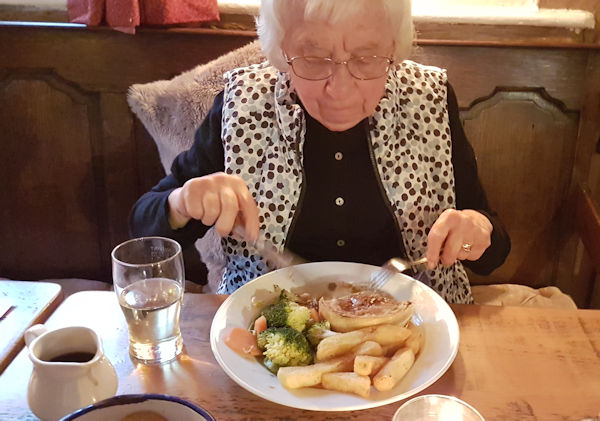
Christine ordered Kate and Sidney (steak and kidney) whilst Mike opted for Moo Bloo (steak with a hint of stilton).Although the menu warns that orders can take up to an hour to arrive (we had heard about this from other reports) ours was much quicker, less than half of that. When the food arrived it was superb. The pies were indeed most delicious with a wonderful crust - quite different from factory made shortcrust of puff pastry, and the accompanying vegetables were just al dente. Too often when kitchens try to do this they end up only on the warm side of raw - or boiled to extinction. These were just right and the chunky chips freshly cooked also to perfection.

After we had polished off all of our potions - and with a short interval to assimilate - we both opted for a creme caramel dessert - again very delicate and something special.

We had been here once before, a long time back when Alice was with us, and we enjoyed it then so it was extra pleasing to find that the place was even better this time. It obviously happily welcomes  families and all sorts of visitors - most tables were tonight occupied by groups - we were one of the few couples. Eventually we had to pay up - the prices are also very realistic and we were not asked to add a separate service charge - so we really did feel that it had been a delight and well worth the money!

4.8 Miles - 8 Locks

Sunday, 15 April 2018

Church and Home

Today we were due to return home but we decided to attend the service at the nearby Wootton Wawen parish church before we hit the road. This meant an early rising (well, 7.30 anyway!) so that we could pack the car in time to get to church for 11 am. We managed this although it was nearly a problem when Mike sat down to finish a mug of coffee and suddenly time evaporated! It took 4 or 5 trips up to the car - even though we were now moored on the far side of the marina with a shallower slope to the car park, it was still quite an exercise.


The church had a number of unusual features, including these 'cages' for the choir. We learnt later that they were originally small vestries which were then adapted for this purpose but it did feel a bit of a reaction to 'naughty' West Gallery choirs who tended to slope off to the nearby pub during lengthy sermons!


The service was conducted by a hospital chaplain helping out for the second time as the vicar is unwell at the moment although hoping to return to work  gradually in the near future. There was a modest congregation - around 19 including 4 visitors plus a choir of seven and a pretty competent organist.

Afterwards we enjoyed a mug of coffee and a slice of cake (although the latter we wrapped to have with our lunch in the car . . .) We took a look at a small exhibition of the history of the development of the village since medieval times. There was once a priory but that has long since disappeared.


The main chancel and sanctuary are all but hidden by the choir stalls an then, behind a set of doors, is another chapel.


By the time we left it was around 12:45 but, with an uneventful and unimpeded grip back (although rain and sunshine - mainly the former - sometimes made driving a little challenging).

Saturday, 14 April 2018

Girls Return

Today, Jess and Alice were due to be collected for their trip back back home at the end of the Easter holidays. However, Joanna and Adrian planned a largely off-road bike ride south of Stratford (they have recently bought two new bikes for this sort of activity) and we expected them to arrive at the marina late afternoon. The weather was brilliant - blue skies, sun and warmth! Such a change from the past few weeks and in the afternoon we were able to open the side hatch for the first time this year.

Although we planned a trip into town for this morning, we did not rush things so it was after eleven by the time we had driven to the Park and Ride and then taken the bus into town. (Again, we arrived just as one was ready to depart).


The main feature was to visit Shakespeare's School and Guildhall, a visitor attraction that only opened a couple of years ago. The Guildhall was originally constructed around 1420 by the Guild of the Holy Cross, an organisation that was initially founded to employ priests to says prayers on behalf of its members. Over time, the Guild gained in influence, wealth and importance and, effectively by Elizabethan times, became the town council, overseeing both justice and administration.


Shakespeare's father was not only a prominent member, rising to be the Bailiff for a year (the equivalent of Mayor today), but also fell foul of its laws on four occasions when he was fined for various misdemeanors!

In the 1560's King Edward VI School (often referred to as KES) moved into the Guildhall. At first this was the only building they had but has gradually developed as a modern school on the adjoining site, still using the old building from time to time, mostly for dramatic productions. Right from the outset the school was noted for its attention to drama and it is thought that his seven years at this school laid the foundations for the rest of Shakespeare's career.


The first part of our visit was downstairs where the original Guild gathered for prayers - a recent conservation discovered a hitherto unknown wall painting in what was the private chapel section, where the priests gathered. We watched a couple of video presentations about the Guild and the influence of the school as well as a reconstruction of how the wall painting might have looked. The original is only shown for 45 seconds as it needs to be protected from light to avoid even further deterioration. During the Reformation, instructions were given to deface the painting as being of Catholic origins - as it happened, John Shakespeare was responsible for organising this by having it whitewashed over so at least some indistinct parts remain.

Upstairs we learnt rather more in detail about the way schooling developed. A current pupil of KES introduced us to the Master's Room and also talked about some of the more famous former pupils.


This was followed by the more dramatic part of the visit - where a Schoolmaster (lat: Magister) pretended to give us a taste of life of a schoolboy in Shakespeare's time. We had to recite latin (amor, amo, amas, amamus) and also feel how rote learning and drama were considered the best basis for learning. At least none of us had to suffer the indignity of the birch!


Another part of the upper floor was set out as a later school room - Alice and Jess had the opportunity to try writing with a quill pen and ink - harder then it looks but Jess was especially pleased that she only ended up with just a dab of black on one finger.

Jess had diligently been completing a quiz as we went around and as we left she was awarded a prize, along with Alice!


We made a brief visit to the Guild Chapel next door to the Guildhall. Unlike the rooms we had been in earlier, this had a light and airy feel to it.

Time then to look for somewhere for lunch. Whilst the others would have been quite happy to return to Husskins (although in once case that was because she expected lunch to consist of a chocolate brownie!) but Mike insisted that we check out the options. We ended up in the Emporium Tea Room, part of a small antique arcade. He enjoyed his soup and the others opted for sandwiches. Although the fare was perfectly adequate, it might perhaps (to adapt a well used phrase) 'should have gone to Husskins' . . . Still, Jess was pleased to try out a smoked salmon and cream cheese sandwich, a new experience having only previously had that combination on tiny crackers.


After lunch we wandered through the town centre to the market although it was not the most interesting set of stalls.Time then to catch the bus back to the car and return to the boat, stopping briefly at a supermarket for some food for tonight, in case they all wanted to eat before returning home.

As it turned out, the parents arrived just after 4 and left before 6. We later moved the boat across the marina to one of the pontoons further away from the entrance as we had been asked to do when we arrived.